
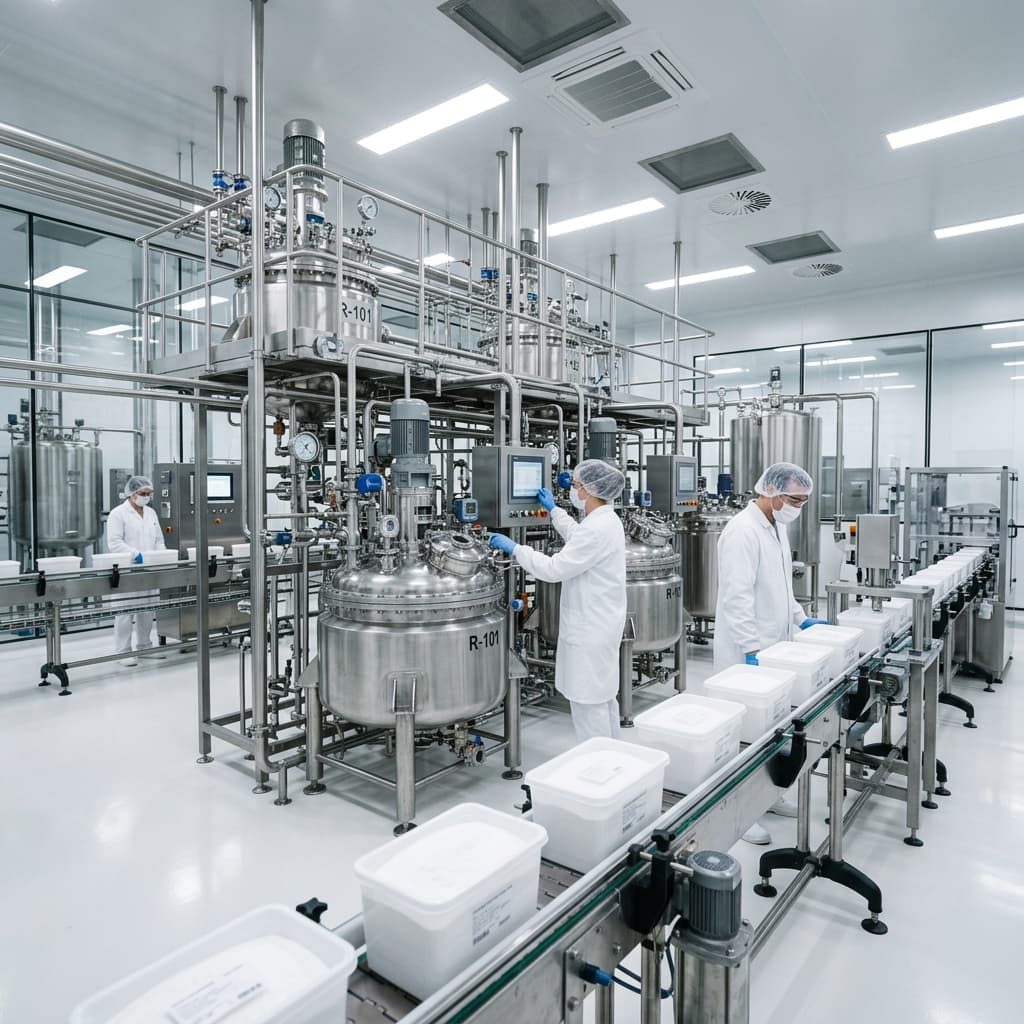
Synthetic camphor (CAS 76-22-2, molecular formula C₁₀H₁₆O) is one of the most important terpene-derived chemicals in global trade. Unlike natural camphor extracted from Cinnamomum camphora trees, synthetic camphor is produced entirely through chemical synthesis — a process that allows manufacturers to achieve consistent purity levels above 99% while scaling production to meet global industrial demand.
India is one of the world's largest producers and exporters of synthetic camphor, with manufacturers concentrated in Tamil Nadu, Andhra Pradesh, and Gujarat. Understanding how camphor is manufactured helps buyers make informed procurement decisions and helps quality managers verify supplier capability.
Raw Material: Alpha-Pinene from Turpentine Oil
The camphor synthesis route begins with turpentine oil — a natural oleoresin product obtained by distilling pine tree resin. Turpentine oil is rich in monoterpene hydrocarbons, primarily alpha-pinene (typically 60–80%) and beta-pinene. Alpha-pinene (CAS 80-56-8) is the key feedstock for camphor synthesis.
The quality of the starting turpentine oil directly impacts the efficiency of the downstream synthesis. Manufacturers source turpentine oil primarily from Pinus species grown in China, Brazil, Portugal, and India. The alpha-pinene content is verified by gas chromatography before acceptance into the production process. Typical specifications require alpha-pinene content above 65% for efficient camphor synthesis.
Step 1: Isomerization of Alpha-Pinene to Camphene
Alpha-pinene undergoes a catalytic isomerization reaction to produce camphene (CAS 79-92-5). This step is carried out in the presence of an acid catalyst — typically titanium dioxide (TiO₂), alumina, or zeolite catalysts — at controlled temperatures between 150°C and 200°C. The reaction proceeds through a Wagner-Meerwein rearrangement mechanism.
The isomerization is an equilibrium reaction, so reaction conditions must be optimized to maximize camphene yield while minimizing the formation of terpinolene, limonene, and other isomeric byproducts. Modern camphor plants achieve camphene yields of 75–85% from alpha-pinene in this step. Temperature control is critical — excessive temperatures favor the formation of p-cymene and other aromatic byproducts that contaminate the final camphor product.
Step 2: Esterification to Isobornyl Acetate
The camphene produced in Step 1 is reacted with glacial acetic acid in the presence of an acid catalyst (typically sulfuric acid or p-toluenesulfonic acid) to produce isobornyl acetate (CAS 125-12-2). This esterification reaction is mildly exothermic and proceeds at temperatures between 40°C and 80°C.
Isobornyl acetate is an important intermediate — it is also commercially valuable as a fragrance ingredient in its own right, used in soaps, detergents, and household products. For the camphor synthesis route, it serves as a purifiable intermediate that can be separated from reaction byproducts by fractional distillation before the next step.
Step 3: Saponification to Isoborneol
Isobornyl acetate is hydrolyzed (saponified) using aqueous sodium hydroxide solution to produce isoborneol (CAS 10385-78-1). This saponification reaction is carried out at 80–100°C and produces isoborneol as a white crystalline solid along with sodium acetate as a byproduct.
Isoborneol is itself a commercially important chemical — it is sold separately as a camphor synthesis intermediate and for use in the fragrance industry. Manufacturers like Kalasam Jaikrishna Industries sell pharmaceutical-grade isoborneol powder and flakes directly to other chemical manufacturers. The isoborneol intermediate is analyzed by GC to confirm purity above 95% before proceeding to the oxidation step.
Step 4: Oxidation of Isoborneol to Camphor
The final step converts isoborneol to camphor through selective oxidation. Historically, this was done using chromic acid (chromium trioxide in sulfuric acid), but modern plants use cleaner oxidants including sodium hypochlorite, hydrogen peroxide with catalysts, or catalytic air oxidation to avoid heavy metal waste.
The oxidation is carried out in batch reactors with precise temperature control. The reaction is monitored by GC analysis of reaction samples to determine conversion. Typical reaction times are 4–8 hours at 40–70°C. The crude camphor is then separated from the aqueous phase and subjected to purification.
Purification: Sublimation and Recrystallization
Crude camphor contains residual isoborneol, reaction solvents, and trace impurities. Purification is achieved through sublimation — heating crude camphor under controlled vacuum conditions so it converts directly from solid to vapor, which is then condensed on cooled surfaces. Sublimation is highly selective and effectively removes non-volatile impurities.
For pharmaceutical-grade camphor (USP, BP, IP specifications), recrystallization from appropriate solvents may follow sublimation to achieve the required 99%+ purity. The final product is white crystalline flakes or powder with a characteristic strong aromatic camphor odor.
Quality Control and Testing at Each Stage
- Alpha-pinene content in raw turpentine: GC analysis, minimum 65%
- Camphene purity after isomerization: GC analysis, minimum 75%
- Isobornyl acetate purity: GC analysis, minimum 90%
- Isoborneol purity before oxidation: GC analysis, minimum 95%
- Crude camphor assay: GC analysis, minimum 95%
- Final product purity: GC analysis, minimum 99.0% (industrial), 99.5%+ (pharmaceutical)
- Melting point: 175–180°C (pure camphor melts at 178.8°C)
- Optical rotation: ±1° (for racemic synthetic camphor)
- Appearance: White crystalline powder or flakes, free from color
- Moisture content: <0.5% by Karl Fischer titration
Production Capacity and Scale at Kalasam Jaikrishna Industries
Kalasam Jaikrishna Industries operates a dedicated synthetic camphor manufacturing plant in Theni, Tamil Nadu, with an annual production capacity exceeding 10,000 metric tonnes. The plant operates 24/7 with continuous monitoring and batch-wise quality documentation. Every batch is assigned a unique batch number and accompanied by a full Certificate of Analysis (COA) covering all pharmacopoeia parameters.
Our manufacturing facility is ISO 9001:2015 certified, and we maintain documented traceability from raw material receipt through finished product dispatch. This full traceability is critical for pharmaceutical and food-grade camphor customers who must maintain supply chain documentation for regulatory compliance.
Frequently Asked Questions
What is the CAS number for synthetic camphor?
Synthetic camphor has the CAS number 76-22-2. The molecular formula is C₁₀H₁₆O and the molecular weight is 152.23 g/mol. It is also known as 2-Bornanone, bicyclo[2.2.1]heptan-2-one, 1,7,7-trimethyl-, or simply dl-camphor.
What is the difference between synthetic camphor and natural camphor?
Natural camphor is extracted from the wood of Cinnamomum camphora trees by steam distillation and exists as dextrorotatory (D) camphor with a specific optical rotation of +41° to +43°. Synthetic camphor is produced from turpentine oil via chemical synthesis and is a racemic mixture (equal parts D and L camphor), giving it near-zero optical rotation. Both have identical chemical formula and similar properties, but natural camphor commands a premium price for certain pharmaceutical and traditional uses.
What purity grades of synthetic camphor are available?
Synthetic camphor is available in several purity grades: Technical grade (≥95%), Industrial grade (≥98%), Pharmaceutical grade (≥99.0% meeting IP/BP/USP pharmacopoeia standards), and High-purity research grade (≥99.5%). Kalasam Jaikrishna Industries manufactures all grades and can provide pharmacopoeia-compliant COA for each batch.
How long does synthetic camphor take to manufacture from raw materials?
The complete synthesis from alpha-pinene to purified camphor typically takes 3–5 days including all reaction steps and purification. However, with modern continuous-flow reactors and parallel batch processing, most large manufacturers can deliver finished camphor within 7–10 working days from order confirmation.
What is the shelf life of synthetic camphor?
Synthetic camphor has a shelf life of 3–5 years when stored properly in cool, dry, well-ventilated conditions away from direct sunlight and heat sources. Camphor is volatile and will gradually sublime even at room temperature, so airtight packaging is important. Storage temperature should not exceed 30°C. Camphor stored in sealed HDPE drums or fiber drums with moisture-barrier liner can maintain specification for 2+ years.
Is synthetic camphor safe for pharmaceutical use?
Yes, pharmaceutical-grade synthetic camphor meets the specifications of major pharmacopoeias including USP (United States Pharmacopeia), BP (British Pharmacopoeia), and IP (Indian Pharmacopoeia). It is used in approved topical medications, rubefacients, and analgesic preparations. The key requirement is that the camphor meets the pharmacopoeial purity specification of ≥99.0% and passes all identity and related substance tests.
Kalasam Technical Team
Quality, Manufacturing & Export Divisions